
Recovering Enchantment: Learning to Read Symbolically
We no longer see the world the way our ancestors did.

Unlock the timeless wisdom of the West—join The Occidental Tourist for insights into the books and ideas that have shaped history, culture, and the human spirit!

We no longer see the world the way our ancestors did.
Not because the world has changed—
but because our way of seeing has.
What if meaning isn’t something we invent…but something revealed through the language of nature?
“See the world anew.”
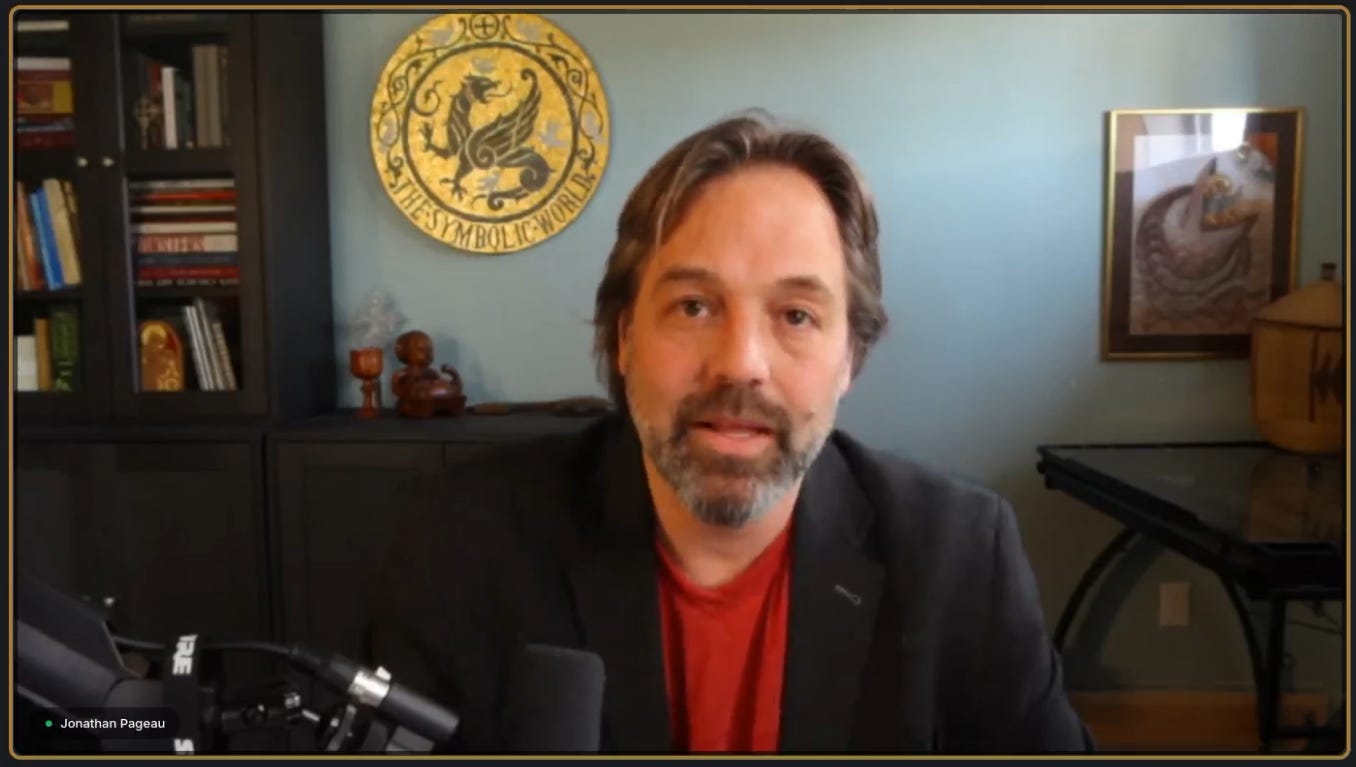
After spending the past year finishing my Master’s degree in Humanities, I’m finally returning to this series on symbolic thinking and the recovery of enchantment. With Symbolic World Summit 2026 approaching later this month, now feels like the right time to continue the series I began last year on Jonathan Pageau’s Symbolism Masterclass. (See Part I and Part II for context.)
This essay picks up the conversation at the point where Pageau explains how to read the symbolic structure of reality itself—an approach that enables us to experience the world as our ancestors once did: charged with beauty, order, and meaning.
What This Essay Explores
Why the modern world feels “disenchanted”
How symbolic thinking restores meaning
A simple framework for seeing patterns in reality
The Problem: Disenchantment
Much of Pageau’s work over the last decade can be described as a sustained critique of the materialist logic of modernity. His Symbolism Masterclass brings this critique into sharper focus. Lesson 1, How Meaning Structures the World, argues that modern philosophical shifts have fractured the relationship between meaning and reality, producing a disenchanted worldview. Lesson 2, Heaven and Earth, reconstructs the hierarchical cosmic pattern found across traditional cultures.
This essay synthesizes Lessons 3 and 4. Pageau contends that by reducing existence to matter and quantity, the modern worldview obscures the central symbolic structure of reality: the interplay between unity and multiplicity.
Pageau’s Claim: Reality Has Structure
Pageau teaches us to recognize the recurring fractal patterns found across Scripture, literature, fairy tales, and creation itself. He argues that symbolic perception allows us to recover a sense of order and enchantment lost in the ideological claims of modernity. To counter its reductive logic, we have to learn to reconstruct the lost hierarchies of meaning and identity.
The Goal: Learning to See Again
Building on Pageau’s framework, this essay outlines a path toward symbolic literacy:
Perceive reality through recurring fractal patterns
Recognize symbolic dualities (heaven/earth, head/body, center/periphery)
Understand analogy as a mode of knowledge
Apply symbolic interpretation to great literature and sacred texts
My aim in sharing this material is to help others become better readers—not only of texts, but of reality itself.
“As scientific understanding has grown, so our world has become dehumanized. Man feels himself isolated in the cosmos, because he is no longer involved in nature and has lost his emotional ‘unconscious identity’ with natural phenomena.”
Carl Jung, Man and His Symbols
Reality as Pattern: Microcosm and Macrocosm
In these lessons, Pageau unpacks his central claim that reality consists of fractal patterns—repeating structures that manifest across all levels of being. Recognizing these patterns allows us to understand how the world works and to clarify our place within it, as humanity serves as a microcosm of the macrocosm—the cosmos in its entirety. One of the clearest representations of this structure appears in traditional Christian architecture, where nested arches symbolize the connection between heaven and earth—a sacred space inhabited by humankind.
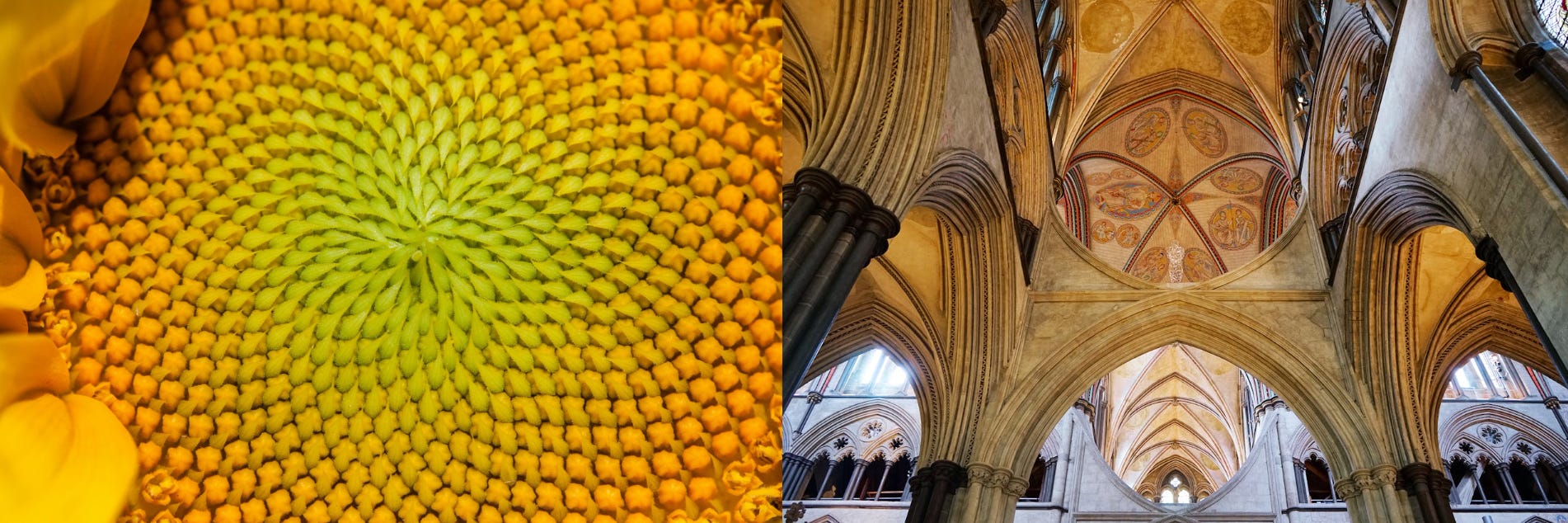
As the Romantic poet Samuel Taylor Coleridge observed, recovering symbolic vision restores “forgotten truths about [our] inner nature.”1 By contrast, the defining ideologies of late modernity have diminished our capacity for symbolic perception—especially the strain of scientific materialism that seeks to reduce consciousness, value, and transcendence to mere quantity and matter. Seeing beyond the material requires active engagement with the world of meaning— attuning ourselves to the “vocabulary of symbols” present in both nature and ourselves.2
Analogy as Participation
Earlier lessons also examined how late scholastic philosophical developments—particularly nominalism and voluntarism—undermined confidence in universal forms. While these debates may seem arcane today, their cumulative effect was to narrow the Western understanding of reality, portraying it as merely material, immanent, and devoid of intrinsic meaning—a disenchanted world.
Symbolic thinking, by contrast, widens our perspective through analogy. As Pageau observes,
“Things are like other things—not in identical sameness, but in participatory likeness.”
For example:
The sun is not God, but we associate its properties with divine wisdom—elevated, radiant, illuminating.
Sunlight analogously reveals how truth enlightens understanding.
From this foundation, Pageau introduces the primary symbolic structure:
“In the beginning, God made the heavens and the earth.” (Gen. 1:1)
This duality is metaphysical as well as scriptural. Heaven corresponds to form, purpose, and intelligence; it’s traditionally the masculine principle. Earth corresponds to matter, multiplicity, and manifestation—the feminine principle.
Pairs and Patterns
The following are some of the key symbolic pairings that establish identity and hierarchy:
Heaven / Earth
Head / Body
Center / Periphery
Right / Left
In each pair, the first term represents unity—order, intelligibility, and purpose—while the second represents multiplicity—the diverse and particular. Keep in mind that their relationship is not inherently antagonistic; rather, multiplicity flows from unity and ultimately returns to it. When properly ordered, they form a “fruitful marriage” whereby spirit is wedded to matter.
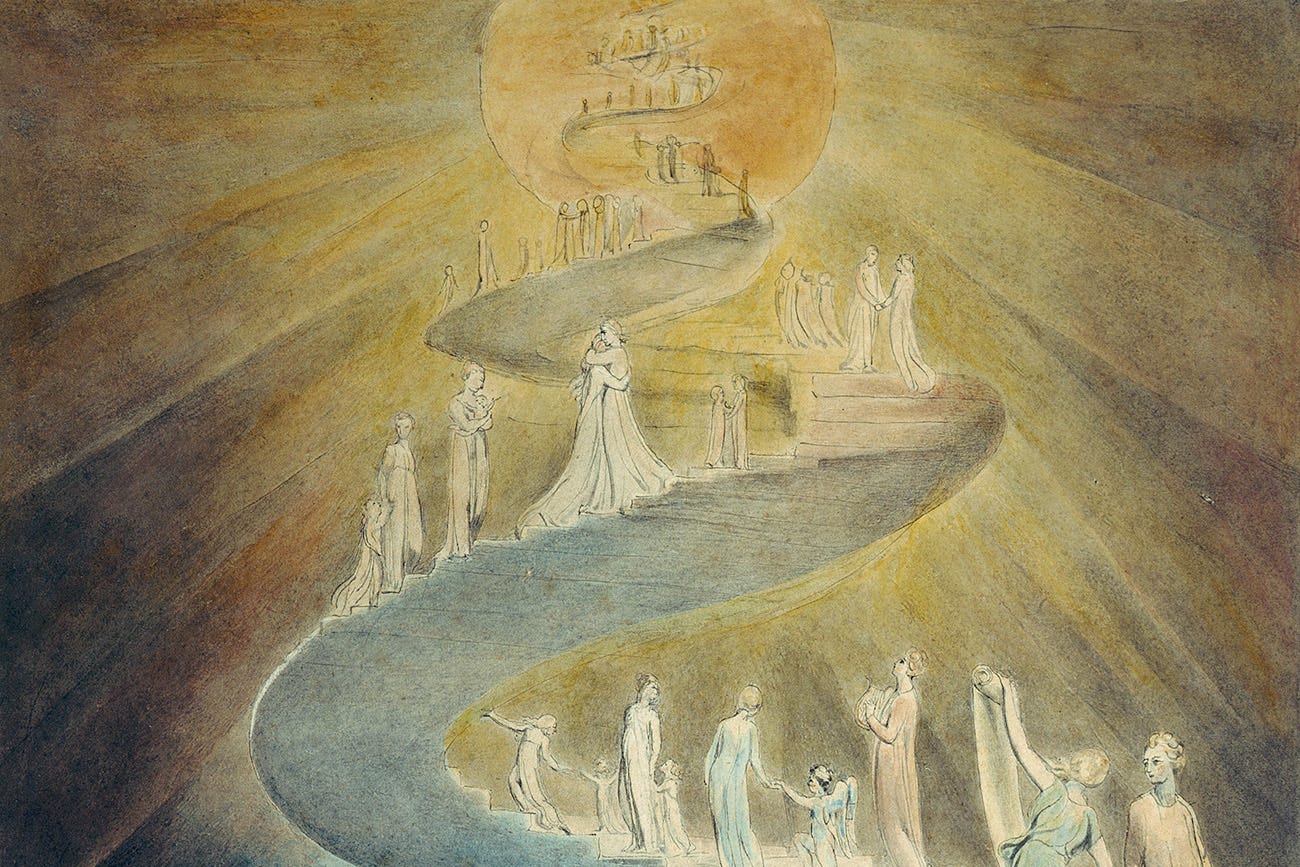
Pageau points to the biblical story of Jacob’s Ladder—where the patriarch Jacob dreams of angels ascending and descending—to illustrate how unity and multiplicity are linked across levels of being: the stone beneath Jacob’s head symbolizes materiality rising toward the heaven of meaning and purpose.
This same structure appears in myths and fairy tales—for instance, Jack and the Beanstalk echoes the ascending pattern.
Symbolic Head and Body
Returning to the solar analogy:
The sun symbolizes intelligence—the faculty of the head
The head governs and gives identity to the whole
The body comprises a multiplicity of parts unified in purpose
Thus, a healthy hierarchy depends on proper integration. For Pageau, the dynamic that holds unity and multiplicity together is “love”. Without it, the system collapses:
Excess head → tyranny
Excess body → chaos, anarchy
Body without head → disordered power (the “giant”)
Pageau interprets the Tower of Babel as a symbolic failure of this balance: the concentration of material power and purpose in an attempt to rival divine authority. It represents the tyranny of the “head,” the result of too much emphasis on unity and uniformity. As Genesis reveals, such a structure necessarily collapses when it becomes too top-heavy to sustain itself.
Why This Matters Now
A culture that loses symbolic perception eventually loses meaning itself, because knowledge is communicated through symbol, image, and metaphor. Meaning-making is a shared endeavor.
When reality is reduced to matter alone, the basis for value evaporates: hierarchy collapses into power, beauty into subjective preference, and truth into utility. This does not result in liberation but in spiritual exhaustion. The train of progress continues to move, but it has no telos, no destination.
Recovering symbolic perception is therefore not an exercise of fantasy. It is the apprehension of reality in its fullness.
Reading Symbolically
These patterns aren’t just for metaphysics—they extend into any body politic:
Social structures
Political systems
Narratives and archetypes
For readers of classic literature, this approach is transformative. Try reading any of Plato’s dialogues through a strictly materialist lens and you are likely to miss his main point. That is how some readers come to interpret The Republic as a blueprint for a communist utopia rather than a polysemous myth: a city that can only exist in imagination and speech.
I’ve previously written about Mortimer Adler’s approach to analytical reading, which asks four questions:
What is the book about?
What is being said in detail?
Is it true, in whole or in part?
What of it?
Symbolic perception adds another dimension:
What pattern is being enacted?
What hierarchy is being upheld—or subverted?
A symbol always points to something beyond itself—and we ourselves are symbols of a divine order. In future posts, I will explore how to apply symbolic reading to Great Books, sacred texts, and contemporary culture. To recover the language of symbols is not merely an intellectual exercise.
It is part of the work of renewing civilization itself.
Like many websites, The Occidental Tourist uses affiliate links, which allows us to earn a small commission on any qualified purchases, at no additional cost to the buyer.
S. T. Coleridge, quoted in Tom Chetwynd, A Dictionary of Symbols (London: Granada, 1982) 390.
Malcolm Guite, Faith, Hope and Poetry (Farnham: Routledge, 2012), 207.
This is awesome! It seems as if we are interested in, and passionate about, the same things. Thanks for this insightful and concise summary of seeing our world through a symbolic lens!